|
Brief History
The Gloster Meteor was the Allies' first operational jet fighter. Designed by George Carter, it first flew in 1943 and commenced operations on 27 July 1944 with 616 Squadron of the Royal Air Force (RAF). The Gloster Meteor was not an aerodynamically advanced aircraft, nor even the world's fastest aircraft on introduction; its limiting Mach number in a dive was actually slower than the Spitfire's[citation needed], but George Carter and his design team at Gloster had succeeded in producing an effective jet fighter that served the RAF and other air forces for decades.
In early 1946, a Meteor set a World Air Speed Record of 616 mph (991 km/h) True airspeed. Meteors saw action with the Royal Australian Air Force (RAAF) in the Korean War and remained in service with numerous air forces until the 1970s.
The first 20 aircraft were delivered to the Royal Air Force on 1 June 1944 with one example also sent to the US in exchange for a Bell YP-59A Airacomet for comparative evaluation.
Meteor NF14was the final Meteor night-fighter to be produced. First flown on 23 October 1953, the NF 14 was based on the NF 12 but had an even longer nose to accommodate new equipment pushing total length to 15.5 metres and a larger bubble canopy to replace the framed T 7 version. Just 100 NF 14s were built; they first entered service in February 1954 beginning with No. 25 Squadron and were being replaced as early as 1956 with the Gloster Javelin. Overseas, they remained in service a little longer, serving with No. 60 Squadron at Tengah, Singapore until 1961. As the NF 14 was replaced, some 14 were converted to training aircraft as the NF(T) 14 and given to No. 2 Air Navigation School on Thorney Island where they served until 1965.
Production of the Meteor continued until 1954 with almost 3,900 made, mainly the F 8 variant. As the Meteor was progressively relegated to secondary duties in later years, target tug, drone and specialized test vehicles were added to the increasingly diverse roles that this first-generation jet fighter took on.
Meteor Variants
The sole Trent Meteor.In 1945 a single Meteor I, EE227, (right) was fitted with two Rolls-Royce Trent turboprop engines, making it the world's first turboprop-powered aircraft.
Meteor F 1 - First production aircraft built between 1943 and 1944.
Meteor F 2 - Alternate engined version - only one built.
Meteor F 3 - Derwent I powered with sliding canopy.
Meteor F 4 - Derwent 5 powered with strengthened fuselage.
Meteor FR 5 - One-off fighter reconnaissance version of the F 4.
Meteor T 7 - Two-seat trainer.
Meteor F 8 - Greatly improved from the F 4. Longer fuselage, greater fuel capacity, standard ejection seat and modified tail (derived from the E.1/44). This variant was a prolific frontline fighter in RAF squadron service, 1950-54.
Meteor FR 9 - Fighter reconnaissance version of the F 8.
Meteor PR 10 - Photo reconnaissance version of the F 8.
Meteor NF 11 - Night Fighter variant with Airborne Intercept radar.
Meteor NF 12 - Longer nosed version of the NF 11 with American radar.
Meteor NF 13 - Tropicalised version of the NF 11 for overseas service.
Meteor NF 14 - NF 11 with new two-piece canopy.
Meteor U 15 - Drone conversion of the F 4.
Meteor U 16 - Drone conversion of the F 8.
Meteor TT 20 - high speed target towing conversion of the NF 11.
Meteor U 21 - Drone conversion of the F8.
Meteor NF14T WS774 - Service History courtesy of www.meteorflight.com
| Date |
Notes |
| 9th Feb 1954 |
Ready for collection but retained for conversion to navigation trainer
designated NF14 (T). Air Intercept radar removed and replaced by Rebecca
Mk. 4 landing aid. |
| 17th March 1954 |
Delivered to 8 MU, Little Rissington. |
| 14th June 1954 |
228 OCU, All weather conversion unit, RAF Leeming coded "S". |
| 13th March 1958 |
12 MU RAF Kirkbride for storage. |
| 11th May 1959 |
2 ANS RAF Thorney Island coded "D". |
| 17th Jan 1962 |
1 ANS RAF Stradishall also coded "D". |
| 13th May 1964 |
Cat 3 accident. Repaired on site by 71 MU (RAF Bichester), Returned to
service 2nd July. |
| 6th Jan 1966 |
Retired from service and placed in storage at 5 MU, RAF Kemble. |
| 25th July 1967 |
On display RAF Upwood for display allocated maintenance serial 7959M. |
| 1969 |
On display RAF Hospital Ely, painted as 264 Sqn aircraft. |
| 2001 - 2006 |
Restored for static display at Quedgeley. |
| December 2006 - |
Exhibited at Malta Aviation Museum - Ta' Qali Malta |
Restoring the aircraft
Sandy Mullen, John Holder, Sid Griffiths and Alex Walsh have gifted the Foundation with a fully restored Gloster Meteor night fighter Mk 14. David Dalton has paid for the transportation costs to Malta.
WS774 arrived at Malta Aviation Museum during December 2006 in a dismantled state following a land/sea journey on a 40 foot trailer directly from UK.
The Meteor NF14 will join the museum's other british postwar jet aircraft collection, currently consisting of a Hawker Sea Hawk, a DH Vampire, a DH Sea Venon and a Gloster Meteor T7.
Click here to view photographs of the delivery of the Meteors at Malta Aviation Museum
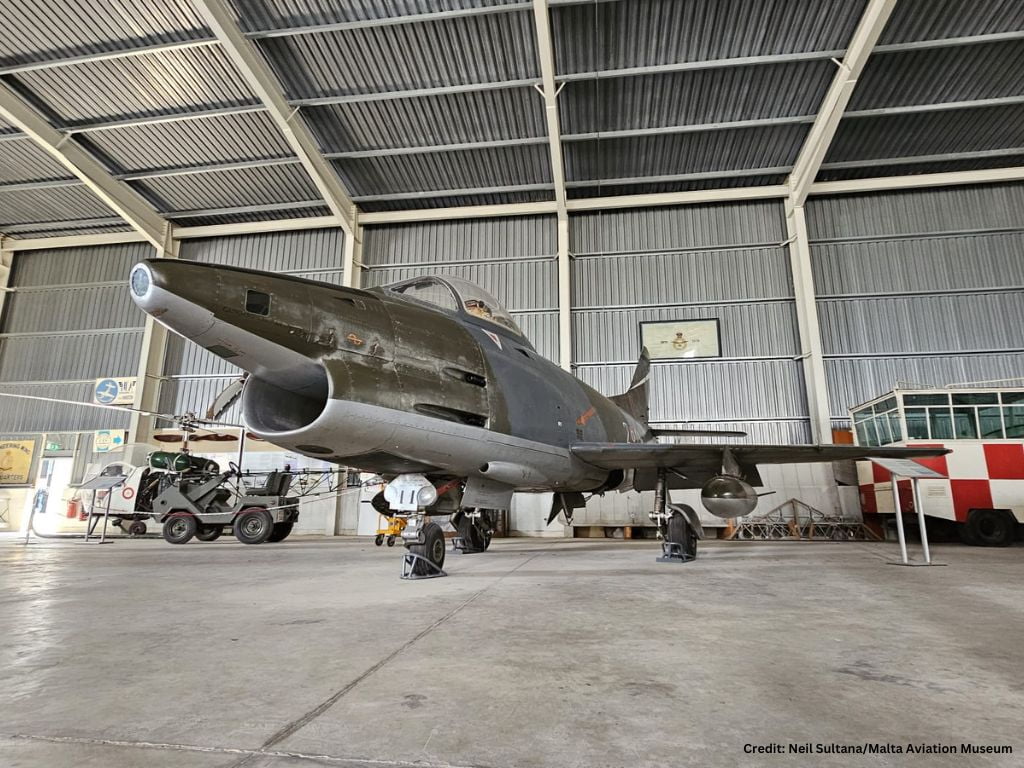
Malta Aviation Museum's Meteor NF14 WS774 as exhibited at Mala Aviation Museum
Malta Aviation Museum's Meteor NF14 WS774 on display at ROC Day Duxford on 14 August 1960
|
 |
|