Top Menu
  English Web Site   Pagna bil-Malti   Deutsche Webseite   Web Page Francaise   Web Page Italiano   Web Page Español   Join Us  | Members' Area  | News & Events  | Donations  | Site Map  | Links  |  
Malta Aviaiton Museum Menu
Home
Aircraft
Autogiro
BAC 1-11
Beech 18S
Cessna Birddog
DC3/Dakota
DH Sea Venom
DH Tigermoth
DH Vampire
EE Lightning
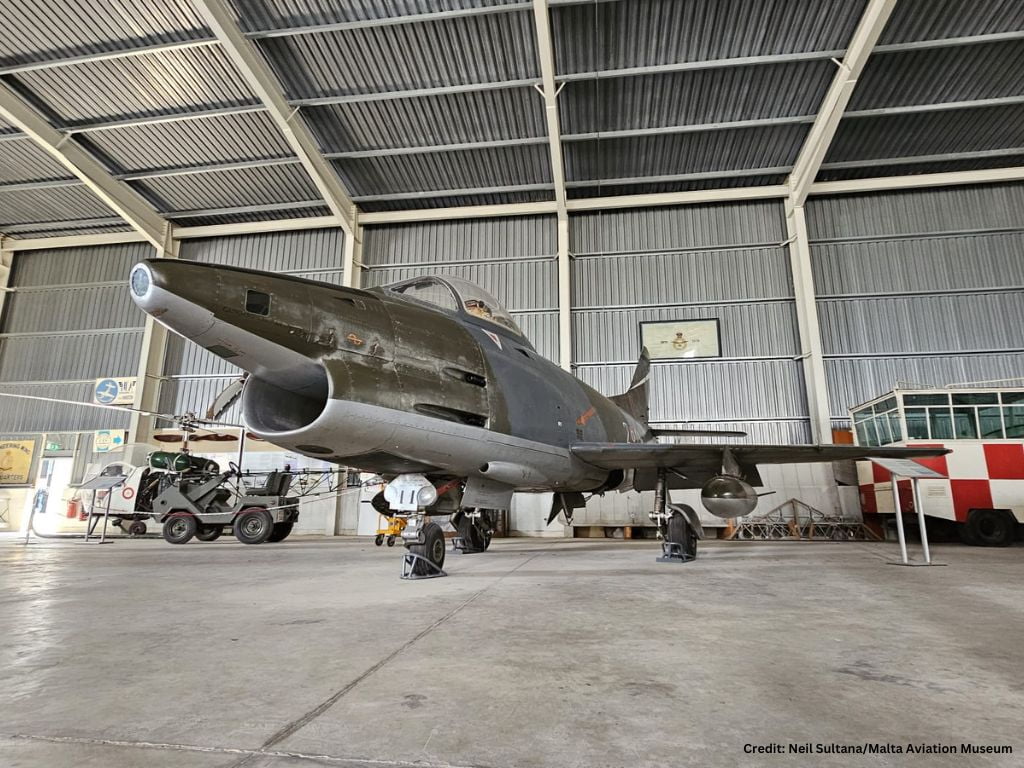
Fiat G91R
Fairey Swordfish
Hurricane MkIIA
Meteor T7
Meteor NF14T
Seahawk FGA.6
Le Pou Du Ciel
Spitfire MkIX
;
; ;
; Welcome to the official website of Malta Aviation Museum ;
English Electric
Lightning F.2
English Electric Lightning F.2 XN769 nose section

The Malta Aviation Museum's Lightning Nose Section

Brief History

A recent addition to the museum's exhibits is the entire nose section, including the nose undercarriage and cockpit, of English Electric Lightning F.Mk 2 XN769. This exhibit was donated to the museum by Mr. Russell Carpenter of Eltham, England, who visited the museum for the first time last year.

Second best only to having a complete Lightning, this exhibit adds a Mach 2 flavour to the Museum and represents the last of a line of the all-British fighter aircraft that had been famous since World War One.

The Lightning at the museum carries N0 92 Squadron's red and yellow markings, which will be retained in order to represent the aircraft of Maltese fighter pilot Flight Lieutenant Mark Micallef Eynaud who flew the type with that unit in RAF Germany.

The Lightning was Britain's first supersonic fighter with a maximum speed and climbing rate that exceeded everything but was limited by it's short range and average weaponry.

The Lightning was the result of the P.1A witch was designed after the demand in 1947 for a supersonic research aircraft. The first of the three prototypes flew in August 1954, and later showed supersonic capabilities thanks to two Bristol Siddeley turbojets without afterburners. It was clear that this type had the qualities of an interceptor-fighter and the name was changed into P.1B witch flew first in April 1957 with two Rolls-Royce Avon turbojets. After a long development period with 20 pre-production aircraft the Lightning F.Mk1 came in use in 1960 with two 30 mm. cannon's and two Firestreak air to air missiles.

Later versions were:

F.Mk1A with air to air refueling capabilities.

F.Mk 2 with improved electronics and adjustable afterburners

F.Mk 3 with Avon Mk 300 engines of 73,62 kN and underwing brackets for disposable fuel tanks, and a straight "cut-off" tail, improved radar, removed machine-guns, and two Red Top air to air missiles.

F.Mk 6 was the last version of the Lightning based on the F.Mk 3A with a redesigned wing, and a fuel tank in the fuselage which practically doubled the fuel-capacity.

Technical Specification
 
Dimensions
 
Performance
Span 34ft. 10in Max. Speed at at 40,000 ft 1,500 mph (Mach 2.3)
Length 34ft. 10in Range 800 miles
Height 19ft. 7in. Ceiling 60,000 ft.
Wing Area 380.1 sq ft Initial Climb Rate 50,000 ft per minute
Power Plant
Weights
Type
Two 13,200-pound thrust Rolls-Royce RA34R afterburning Avon 310 turbojets Empty 28,000 lbs.,
Max. take-off 50,000 lbs.
 
Armament & Equipment
Two 30-mm Aden guns in ventral pack
Two Firestreak or Red Top air-to-air missiles, or
44 50.4-mm (2-inch) rockets, or
Five Vinteen 360 70-mm cameras and linescan equipment and underwing flares
Up to 144 rockets or six 1,000-pound bombs on underwing/overwing hardpoints

Lightning F2 XN769 19 Sqd RAF West Drayton


Learn more about other aircraft at the Malta Aviation Museum Aircraft Exhibits
Autogiro - Beech 18S - BAC 1-11 - Cessna Birddog - Dakota C-47/DC 3 - DH Sea Venom
- DH Vampire DH Tigermoth - EE Lightning - Fiat G-91R - Fairey Swordfish
- Hawker Sea Hawk FGA.6 Hawker Hurricane MkIIA - Le Pou Du Ciel - Meteor T7
Meteor NF14T - Supermarine Spitfire MkIX

Log In ©Copyright - Malta Aviation Museum Foundation - All rights reserved.
 
Website developed by Clifford Delia -