Brief History
In the 1950's, it was realised that most European air forces within N.A.T.O. were mainly equipped with outdated front-line aircraft, most of which had been designed during World War II. It seemed to make sense for these countries to re-equip with one standard type of aircraft, built to a standard requirement. In 1952, N.A.T.O. held a conference in Lisbon. One of the outcomes was a specification for a ground-attack aircraft capable of taking off from stretches of motorway or even semi-prepared strips and was easy to maintain.
Twelve companies responded to that requirement and the Fiat G.91 was declared the winner in 1956. Production started in 1958 as the GR-1 having an armed reconnaissance capability, with three 70mm cameras fitted in the restyled blunt nose. Other variants included the G-91 PAN as used by the world-famous Frecce Tricolori aerobatic team, the two seat G.91T and twin-engine G.91Y. Apart from the Aeronautica Italiana (Italian Air Force) other G.91 operators included the Luftwaffe and Portugese Air Force. The aircraft was also avaluated by the United States Army in America but it failed to gain an order.
The Gina as it was affectionately known by its pilots, was a common site at Luqa in the early seventies, the type visiting Malta on navigational exercises from bases in Italy. On October 1st, 1977, the Italian Aerobatic team made a spectacular display on the occasion of the official opening of runway 14/32's extension.
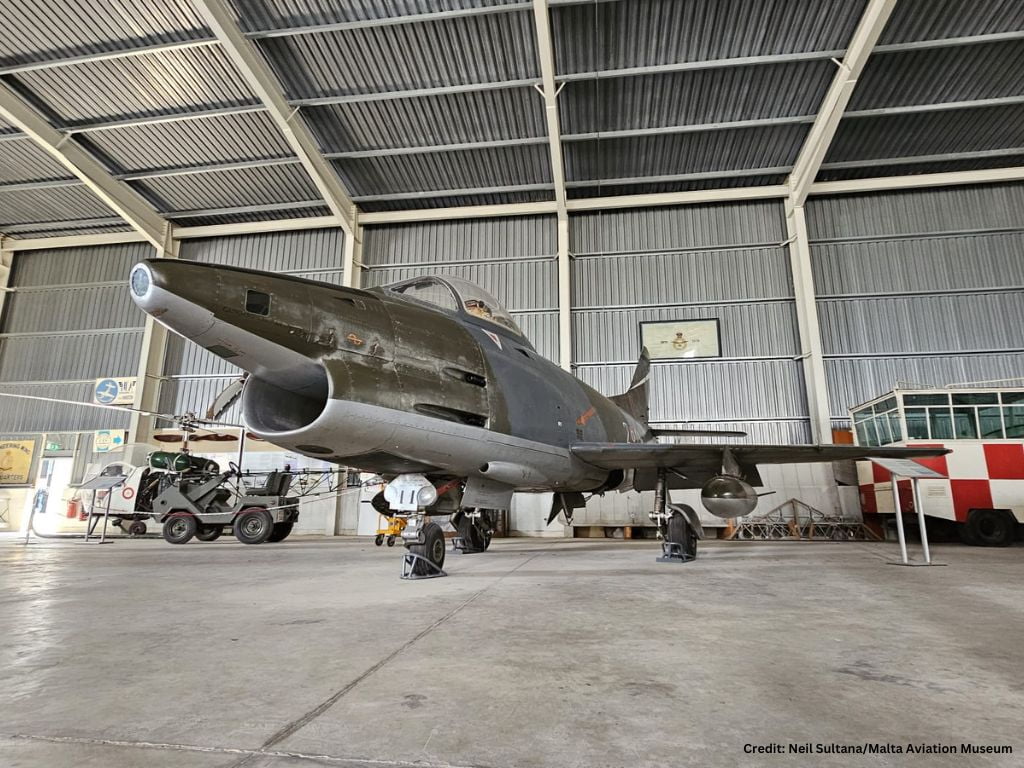
The Museum's Fiat G91R
The Fiat G.91R/1B (Construction number NC191) exhibited at the Museum carries Matricola Militare (military serial) MM.6377, while the code painted on the aircraft is 2-11. In the Italian Air Force's post-war coding system, the 2 in this case represents the 2° Stormo (wing) to which the aircraft was attached and the 11 was the individual aircraft code number. MM6377 formed part of the last batch of single seaters delivered by Fiat to the Italian Air Force from 1964. The aircraft last flew from Treviso Saint Angelo in 1989 (Noth East Italy). It was presented to the Malta Aviation Museum by the Italian Government in 1998 following the kind intervention of Colonel Alberto Zucchi, Commander of the M.I.A.T.M. (Missione Italiana Assistenza Tecnico Militare - Italian Military Mission in Malta).
Technical Specification
 
|
Dimensions
|
|
Performance
|
| Span |
28
feet 1 inch |
Max.
Speed at sea level |
668
mph |
| Length |
33 feet 9 inches |
Initial climb
rate |
6,003 ft/min |
| Height |
13 feet
1 inch |
Ceiling |
42,980
feet |
| Wing
Area |
176.7 square feet |
Ferry Range |
1,150 miles |
|
Power Plant
|
Weights
|
Type
|
One
Orpheus 810-02 Turbojet |
Empty |
6,835
lb |
| Max. take-off |
12,470 lb |
| Thrust |
4850 lb |
|
|
Armament &
Equipment
|
Four
x 12.7mm Machine guns
Three x 70mm Vinten cameras |
|
Fuel Capacity
|
| Stores
load |
1,000 lb |
|
|
|
|
|
|
|
|